When was the last time you truly felt alive? Not simply comfortable or entertained, but completely present. Curious. Energised. Perhaps uncertain, vulnerable or even a little uncomfortable?
That was the question at the heart of a TEDxTheHague Salon I attended at The Social Hub in The Hague in July. The theme was Feeling Alive, and rather than presenting us with a neat set of answers, the afternoon explored a more challenging possibility: perhaps in trying to make our lives safe and comfortable, we sometimes avoid the very experiences that make us feel most alive.
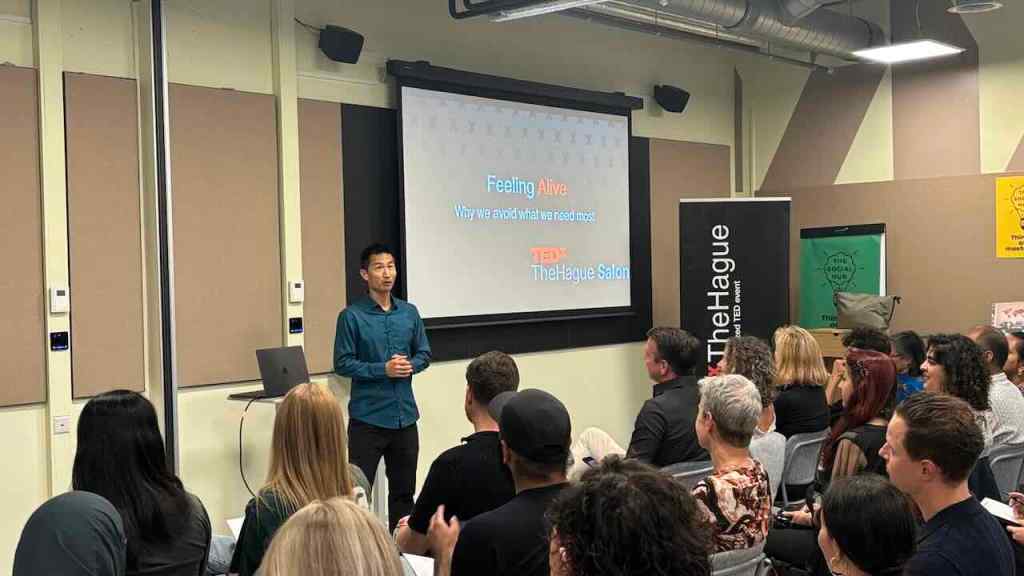
Three very different personal stories explored that idea from different directions.
What happens when you don’t know what happens next?
Wiebe Wakker’s story provides an unusually literal example. In 2016, as a graduation project, he left the Netherlands for Australia in a borrowed electric car. He had no money for the journey and depended on strangers to provide three basic things: food, somewhere to sleep and electricity for the car. It sounds insanely ambitious. But he did it.
What became the Plug Me In project ultimately took him through 33 countries and across 95,000 kilometres before he reached Sydney. The route wasn’t predetermined. People offering a meal, a couch or a power socket effectively helped decide where he travelled next.
One of the things I wrote in my notes was simply: Ask for help.
Wiebe talked about approaching people he didn’t know and discovering, again and again, that when he asked for help, people always helped him. Asking for help means admitting that we don’t completely control what happens next. We have to depend upon someone else’s response. Yet without doing that, much of Wiebe’s journey simply couldn’t have happened.
He described following an idea that other people doubted while experiencing a life filled with freedom and curiosity. There is something important in that combination: not recklessness, but curiosity strong enough to take the first step before knowing exactly how everything will work out.
Seeking discomfort
Manon van der Horst approached the idea much more explicitly. She is part of the wider Yes Theory community, whose philosophy is to seek discomfort – deliberately stepping beyond the familiar as a way of growing. Yes Theory has used the concept for years to challenge conventional choices and encourage experiences outside the comfort zone.
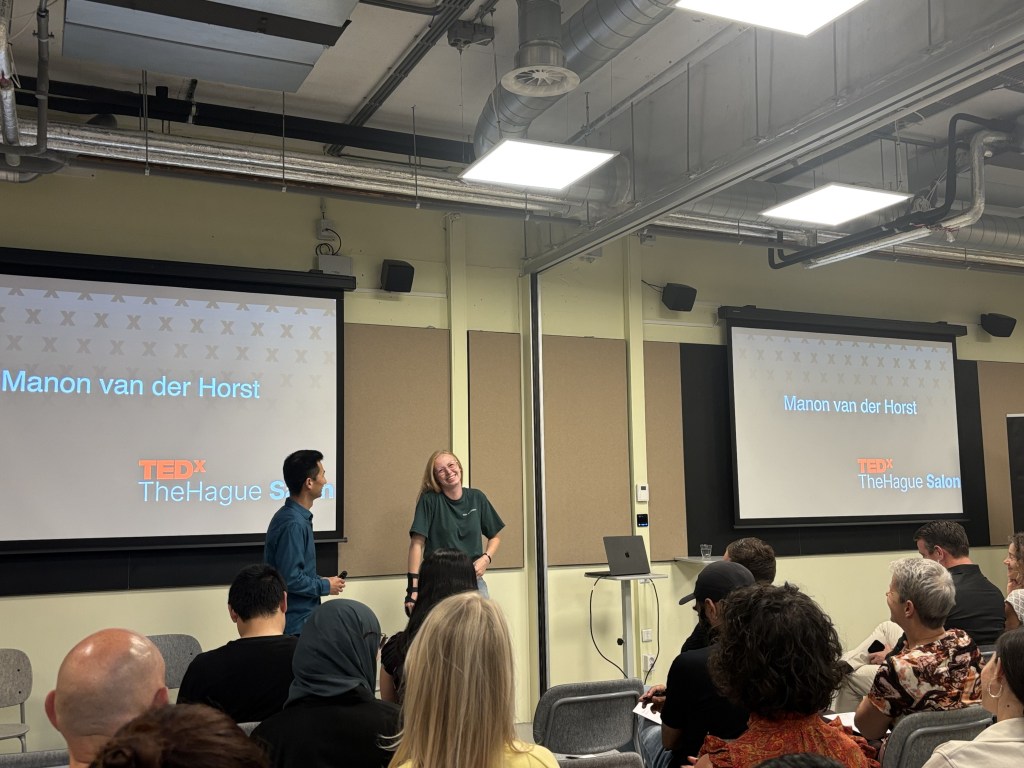
Manon spoke about anxiety as well as adventure. I love that they can coexist, I have my own experiences here to confirm this.
Leaving your comfort zone sounds exciting when packaged as an inspirational slogan. Actually doing it can involve fear, uncertainty and worrying the people who care about you. She spoke about conversations with her mother, who naturally worries about some of the things she does. Manon wants her to trust that she can make her own decisions while also making choices about her safety.
Growth and discomfort aren’t the same as ignoring risk. Sometimes the challenge is learning to live with between both.
Where do I belong?
The story that stayed with me most strongly was Eldin Fajkovic’s.
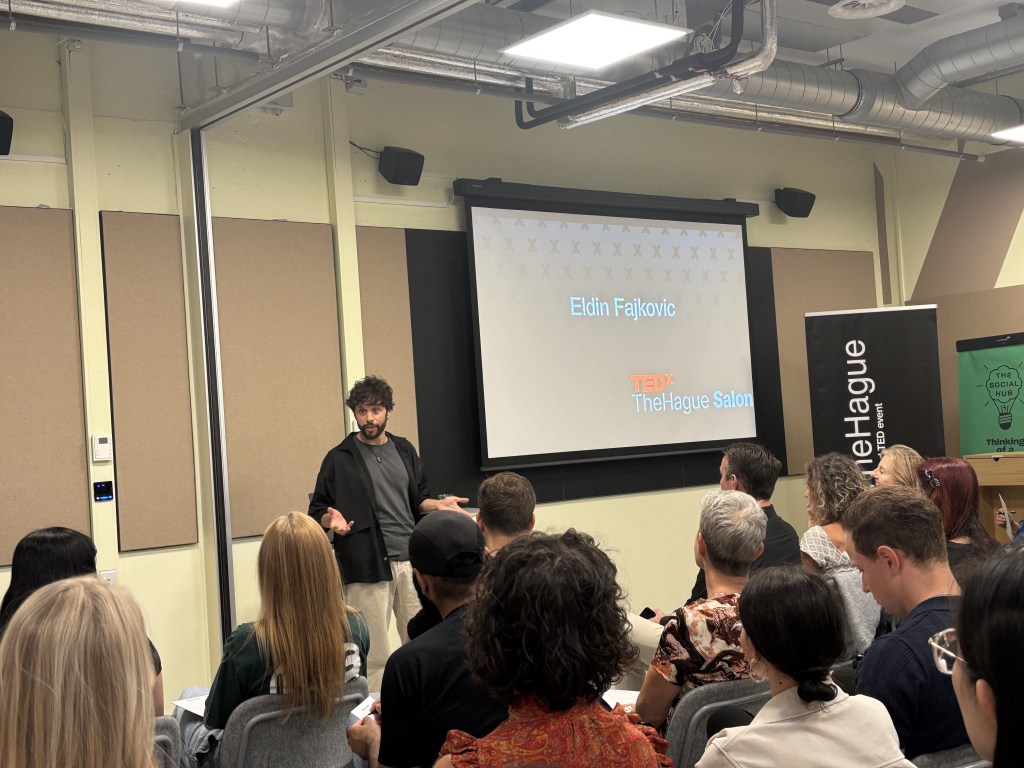
Eldin came to the Netherlands as a young child after his family fled the former Yugoslavia. His story explored belonging, culture and what happens when identity is treated as a choice between one side and another.
There were several points I could relate to, including that my own father was born in the region and moved to Australia before I was born. I also recognised quite a few of the experiences and emotions he shared. I really wish his talk was recorded, he spoke so eloquently and even poetically. I wrote notes as fast as I could, but also just wanted to absorb his talk – which was over way too soon!
My notes use words about roots, language, food, nationality, neighbours, asylum and home. One phrase I really liked:
Belonging is a verb.
Another was:
You don’t have to hide a part of yourself.
His family had arrived in the Netherlands as asylum seekers. He described the gradual process of weaving themselves into life here through language, food, time and relationships. There was resistance too. New neighbours initially petitioned against the family’s arrival yet eventually those same neighbours wanted them to stay.
One particularly beautiful story involved a Dutch child referring to the newcomers not as asielzoekers — asylum seekers — but accidentally as something sounding like zielzoekers: soul seekers.
The mistake contained its own wisdom.
The space between stories
Eldin’s experience also challenged the idea that belonging requires choosing one identity and rejecting another. Bosnia could be part of him. The Netherlands could be part of him. There didn’t have to be a competition between them.
I’ve gone through a similar process and realisation, which I write about in fragments over on Dutch Australian. He put it very succinctly though, something along the lines of:
I was trying to make a choice, but there is no choice to make. You can fully embrace both.
That idea reaches much further than nationality. Many of us carry apparently competing identities, histories, relationships and versions of ourselves. We can spend enormous energy deciding which one is the “real” one. However belonging isn’t about finally finding the correct labels. It’s about something we create through the way we connect with people, places and ourselves.
Feeling alive doesn’t necessarily feel comfortable
By the end of the afternoon, I wasn’t left with a formula for feeling alive. That wasn’t the intention. Instead I came away noticing a thread running through three very different lives. Wiebe had to depend upon strangers. Manon deliberately experiments with discomfort. Eldin had to reconcile cultures and ideas of belonging that initially seemed impossible to hold simultaneously.
Feeling alive isn’t necessarily the same thing as feeling comfortable. It can mean asking someone for help without knowing whether they will say yes. Trying something while still feeling anxious. Entering a community where you may not (yet) belong. Being brave and curious enough to take the next step before you know exactly where it will lead.
I went to TEDxTheHague Salon a little anxious myself. Despite all my years of experience, I still get quite anxious in new groups and a bit overwhelmed at events. However I’m glad I also confronted my own challenges and went a bit outside my comfort zone.
It was incredibly inspiring to listen to the three speakers. There was also the opportunity for a group discussion afterwards. I was not feeling up for it, so had a drink and something to eat at The Social Hub bar – and ended up having a really lovely one to one conversation which, indeed, made me feel alive!


