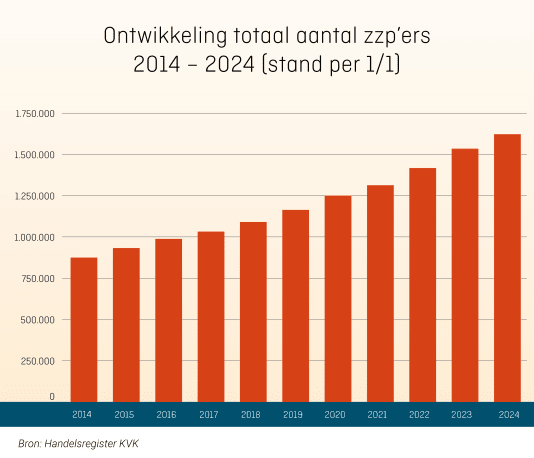
The number of self-employed people without personnel (zzp) increased by 85% between 2014 and 2024. In 2014, the Netherlands had some 875,000 self-employed people. Now, 10 years later, there are just over 1.6 million.
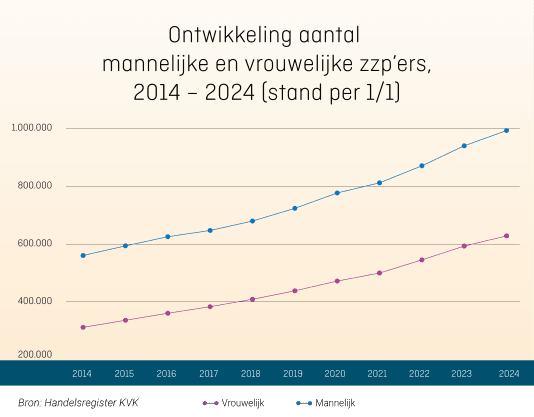
The number of female self-employed has grown significantly more than the number of male self-employed, at +101%, compared to +77% for male self-employed.
At 61%, the share of men is still higher than the share of women (39%) within the group of self-employed.
This distribution is fairly similar to that among non-zzp entrepreneurs, for example SMEs and large companies (67% male and 33% female).
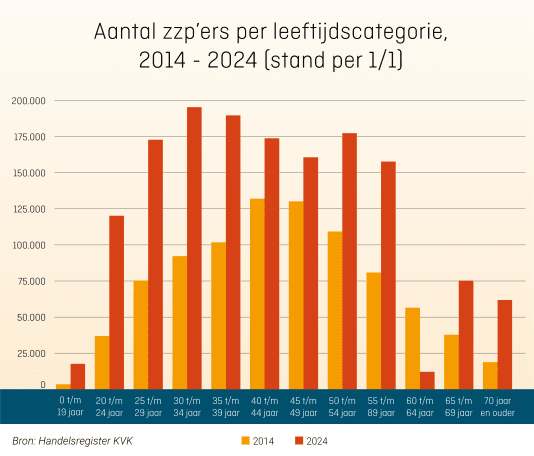
The strongest growth in self-employment occurs in the youngest age groups (0-19 years and 20-24 years) and in the higher age group (65 plus) with the strongest increase within the highest age group (70 plus).
In almost all sectors, the number of self-employed workers has increased sharply over the past decade. The increase is strongest in logistics, hospitality, healthcare and construction. The only sector in which the number of self-employed dropped is wholesale trade. Business services have by far the most (in absolute numbers) self-employed workers, at 440,010, followed by construction (218,369) and healthcare (202,963). Of the total number of self-employed in the Netherlands, 27%, 14% and 13% are in these sectors respectively.
Development female self-employed
In absolute terms, the number of self-employed women grew the most in the healthcare sector, from 64,210 in 2014 to 151,193 in 2024, an increase of 135%. The share of female self-employed in this sector remained the same at 75% over the past decade. The number of female self-employed workers also increased sharply in business services (+83,603). The share of female self-employed is highest in personal services (90%) and lowest in construction (1%).
‘The proportion of female self-employed workers rose from 36% in 2014 to 39% in 2024. They are mainly active in healthcare and business services, the sectors they have been working in for many years. We often think that female self-employed people only work in personal services and in the healthcare and welfare branches, but the majority still work in business services. For example, as an independent lawyer or communications consultant,’ said Josette Dijkhuizen, entrepreneur, associate professor (Tilburg University) and Crown member of the Social and Economic Council (SER).
Women in agriculture and horticulture
The share of female self-employed workers rose most sharply between 2014 and 2024 in agriculture and horticulture, from 8% to 17%. In absolute numbers: 2,113 in 2014 and 5,601 in 2024.
Jessica Peters is one of the women in this group. She started an agricultural education three years ago, at 39, and now she grows vegetables, herbs, fruit and flowers naturally at Van de Pallande garden farm in Oirschot. ‘I spent years as an engineer supervising large IT transformations at corporates, but also always said I wanted a farm with a goat “later when I grow up”. So I started with a part-time MBO agriculture course.’ There, Peters immediately saw that as a woman, she was indeed no exception; 23 out of 25 classmates were women. ‘Why is that so? Perhaps women are naturally more concerned with connection. For example, between man and nature, between people, and with my background also with technology. In my view, connection is necessary to enable future-proof agriculture.’
She also finds that experiences from a previous career can definitely come in handy after such a big transition. ‘I try to connect my “two worlds” anyway, and am, for example, working on what robotisation and the use of data can mean for the future of small-scale agriculture.’
LTO Agriculture and Horticulture Organisation (LTO) sees in its constituency that more and more women are choosing entrepreneurship and taking active responsibility for the agricultural business. ‘We think it is a great development that women are also taking up this gauntlet. This is also one of the reasons we have the ‘Women and business’ programme. Within this, LTO sees an increasing interest in, among other things, exchanging knowledge and experience and increasing awareness among women of their financial, social and societal role and position,’ said Eric Douma, Portfolio Holder Entrepreneurship & Education LTO Netherlands.
Young and older self-employed
The trend of increase among the lower and higher age groups has been noted by KVK before. Among young people, the increase is probably related to much attention to self-employment within education, the digital literacy of this generation, low barriers to many digital activities such as vlogging and blogging, and role model icons on social media. A growing share of self-employed among young people (up to 24 years old) is especially noticeable in retail, hospitality and, to a slightly lesser extent, logistics. The latter include courier services.
Among older people (65 plus), growth is mainly in financial services and, to a slightly lesser extent, in wholesale. In the 65-plus group, it seems to be a combination of being forced to continue working due to insufficient pension and wanting to remain active.
Additional growth likely related to corona
The increase in the total number of self-employed over the past decade has averaged 6.4% per year. Outliers can be seen in the years 2021 and 2022 (plus 7.9% and 8.3% respectively ), which may be related to the corona crisis, which caused many people to start something for themselves. Last year (2023), growth weakened slightly (5.7%).
‘The stronger growth can partly be explained by the pandemic, but at the same time we mainly see a growth of self-employed people in branches within the healthcare sector. In that sector, many self-employed people started in recent years because they wanted more flexibility in working hours, wanted to get a better grip on the workload or missed the appreciation in paid employment,’ Dijkhuizen said.
Top 10 industries with the strongest growth in number of self-employed:
1. Support and guidance for the disabled
2. Laying electricity and telecommunication cables
3. Internet retailing of a general non-food range
4. Ambulatory youth care
5. Social work
6. Private security
7. Other business services (rest)
8. Public relations and communication consultancies
9. Communication and graphic design
10. Land transport services
Source & more information: https://www.kvk.nl/pers/aantal-zzpers-afgelopen-tien-jaar-met-85-gestegen/
 Zestee