On 27 April, many Dutch people head out to celebrate Koningsdag. A significant number of people will sell or buy old household goods such as CDs, books, clothes, toys and household appliances on this holiday.
A survey by OPEN Foundation, known for Wecycle and Wecycle for businesses, found that 82%* of Dutch people think that Kings Day teaches children to be smart about their belongings. 36%* of Dutch people even think that Kings Day is the most sustainable holiday of the year, and 94% of those surveyed know that electrical appliances left over on Kings Day should be handed in for recycling.
On average, 33% of sellers expect to sell between 10 and 50 euros worth of items during King’s Day. In addition, 34% hope for proceeds between 50 and 100 euros.
Free market is a sustainable learning opportunity
82% of the Dutch believe that the free market on Kings Day teaches children to be smart with their belongings. In addition, some 77% think it is a good example of how the Dutch deal smartly with their unused stuff, and that you can find good deals on 27 April.
For the OPEN Foundation, Kings Day is a particularly important day when it comes to recycling electrical appliances. We all know the situation: cupboards and drawers full of old mobile phones, toys with cords or on batteries, game consoles or obsolete audio equipment. On 27 April, many people actually go out to score good bargains. So it is a great opportunity for sellers to empty the cupboards, make some extra money and be sustainable at the same time.
Who buys what
The research, conducted by Markteffect, shows that both men (51%) and women (54%) look for books, music and videos on King’s Day. Interestingly, clothes and (non-electrical) toys are much higher on women’s priority lists than for men during this festive day. On the other hand, electrical appliances, electric toys and lamps score significantly higher among men.
What sellers do with leftover electrical appliances
It is clear to 93% of those surveyed that electrical appliances should be handed in separately for recycling. This is done, for example, at the charity shop (33%), the environmental street (30%) or at a Wecycle return bin (21%). In addition, many people still try to sell the products (28%) or give them away (28%).
Municipalities play an important role
As many as 88% of Dutch people think it is important or very important that their municipality provides support for information and collection of electronic waste after the free market.
Many municipalities facilitate this with an extra opening of the recycling centre or extra long opening hours and inform residents about drop-off points, for instance through their social media channels or the local newspaper.
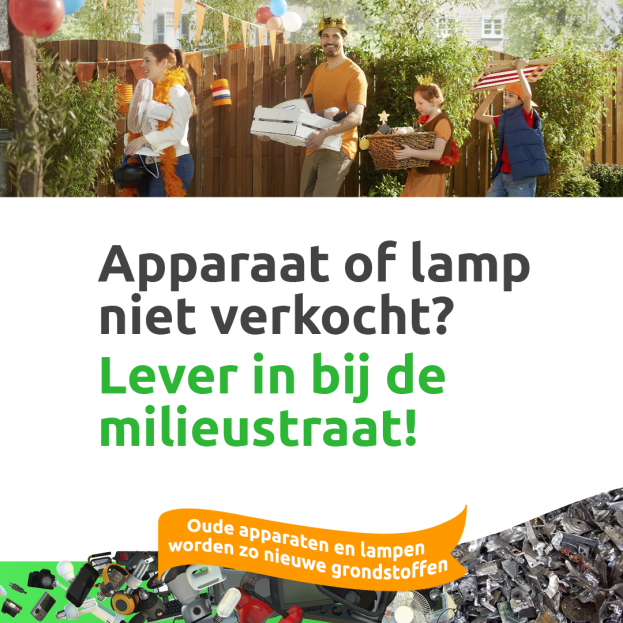
The OPEN Foundation, known for Wecycle and Wecycle for businesses, also calls via a campaign to recycle electrical appliances via, for example, the environmental street or Wecycle return points.
Steven van Eijck, chairman OPEN Foundation: ‘We wish everyone a happy King’s Day and good luck if you go selling. If you have any discarded appliances at the end of the day; hand them in at a Wecycle hand-in point.
About OPEN Foundation and Wecycle
Stichting Organisatie Producentenverantwoordelijkheid E-waste Nederland (OPEN) is responsible, on behalf of all producers of appliances, batteries and light bulbs in the Netherlands, for the collection and recycling of these products. Our goal is to achieve the legal collection target and to make these products circular. We do this together with our collection, sorting and recycling partners. Under the name Wecycle, we run campaigns to stimulate collection and recycling. Consumers and companies can hand in free of charge at one of the Wecycle collection points throughout the country. Find them via this link:
https://inleverpunten.stichting-open.org/
 Zestee