Designed to make sure Artificial Intelligence (AI) is used safely and ethically across Europe, the EU AI Act like a rulebook for AI development and use. AI is a powerful tool, but it can also be risky. What’s the EU Act all about, and what do you need to know? Fiona Passantino gives us the basics in plain Human language.
What’s the EU AI Act?
On March 13, European lawmakers officially passed the Artificial Intelligence Act. By far the strongest of its kind, this groundbreaking law defines and regulates the development and use of Artificial Intelligence (AI) systems for the private and public sectors[i]. The purpose is to ensure that AI is built and integrated into our systems in a way that protects our rights and safety, while still allowing for innovation and advancement as we move into the next phases of AI development.
So far, this law has all affected parties complaining in equal measure. This is generally a sign of some degree of fairness. As a Human user, it outlines a number of basic rights, which we also see with other EU agreements when we travel, use the internet and enter into cross-border contract agreements.
Ever since we have been sending out our first prompts, the European Parliament has been concerned about AI hallucinations; its tendency to produce factual errors and plain-old make stuff up, and our Human tendency towards the viral dissemination of deepfakes and other manipulation of reality[ii]. Left unchecked, this can mislead us Humans in all sorts of ways, from swaying elections to exposure to liability, character defamation, impersonation, identity theft and more[iii].
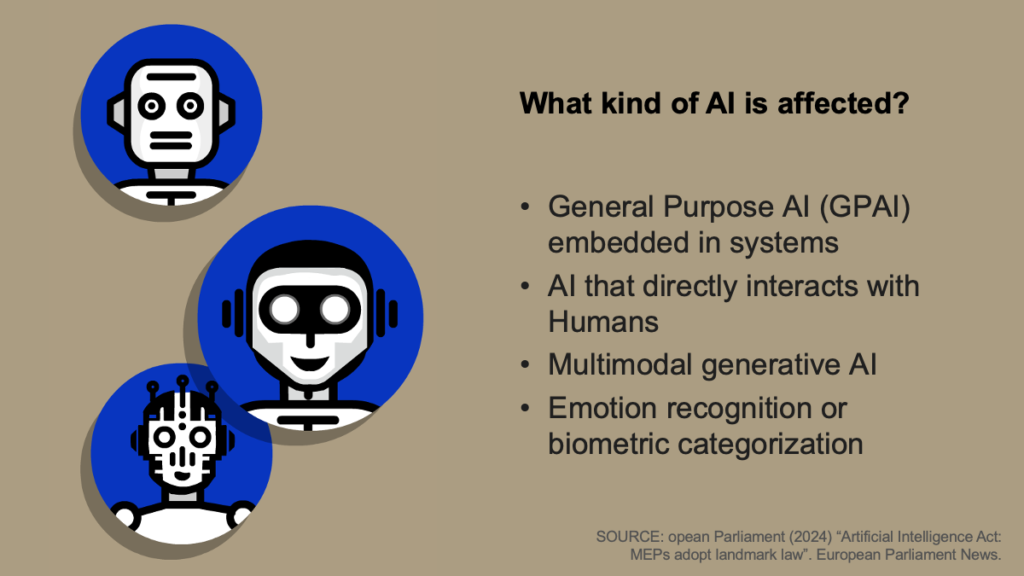
What kind of AI is affected?
Your friendly text generative AI – ChatGPT, Microsoft Co-Pilot, Google Gemini or Claude – are mostly safe. This act goes for General Purpose AI (GPAI) embedded in systems we use every day, sometimes without our even being aware.
The AI systems targeted by the Act are those that directly interact with Humans (AI agents) or those generating audio, image, video or musical content (Midjourney, DALL-E, etc.), those engaging in emotion recognition or biometric categorization (ShareArt) and those designed to create deep fakes (HeyGen, ElevenLabs)[i].
What are my rights as a Human?
The nice thing about this Act is that we, Humans, now get to enjoy certain rights baked into our AI experience.
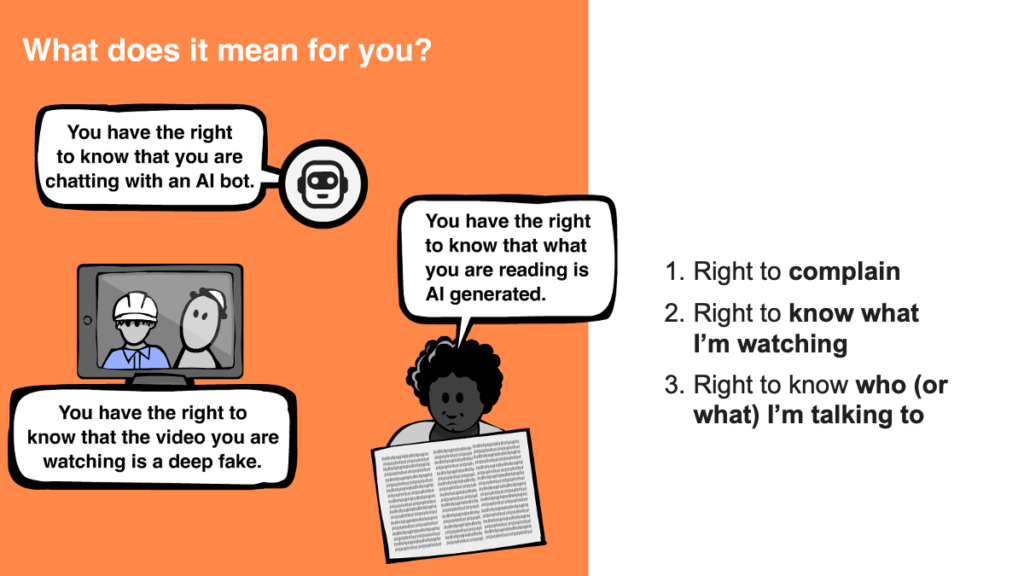
- Right to complain
Humans have the right to hold the system suppliers accountable about decisions made that affect them, and get an explanation. Imagine you are applying for a job and are turned down; you suspect the AI software filtering your application out is using a discriminatory algorithm. Under this Act you would have the right to petition the company for an explanation of the decision-making process. Businesses that use high-risk AI need to be transparent and make sure their systems are accurate.
- Right to know what I’m watching
Humans have the right to know that the cat videos they are seeing on YouTube or Instagram are real or not. Fake content will need clear labels; a watermark, disclaimer or visible tag.
- Right to know who I’m talking to
Humans have the right to know that the friendly person at the other end of a service line is another Human or an AI-powered bot. As these tools get more and more adept at their use of language, ever more Turing-test capable, these labels will become ever more necessary.
Click through to read more of this informative article over on Fiona’s blog….
About Fiona Passantino
Fiona is an AI Integration Specialist, coming at it from the Human approach; via Culture, Engagement and Communications. She is a frequent speaker, workshop facilitator and trainer.
Fiona helps leaders and teams engage, inspire and connect; empowered through our new technologies, to bring our best selves to work. She is a speaker, facilitator, trainer, executive coach, podcaster blogger, YouTuber and the author of the Comic Books for Executives series. Her next book, “AI-Powered”, is due for release soon.

 Zestee